
New Dubai school admissions age rules 2025–26: What the KHDA cut-off change really means for parents
New Dubai school admissions age rules 2025–26: what the KHDA cut-off change actually means (without the panic)
Yesterday, the UAE announced a change that has sent a lot of parents straight to Google (and ChatGPT)— especially mums with little ones who are anywhere near school age, or even just thinking ahead. If you’ve got a child born in the latter part of the year, you’ve probably already asked yourself:
“Does this mean they have to start school earlier now?”
“Are they suddenly going to be the youngest in the year?”
“And… what do all these year group names even mean anyway?”- I know I still don't understand that one fully, and mine is almost 6 and in Year 1! It gets even harder when I try to compare it to the Scottish school system, which is what I grew up in.
So, what has actually changed?
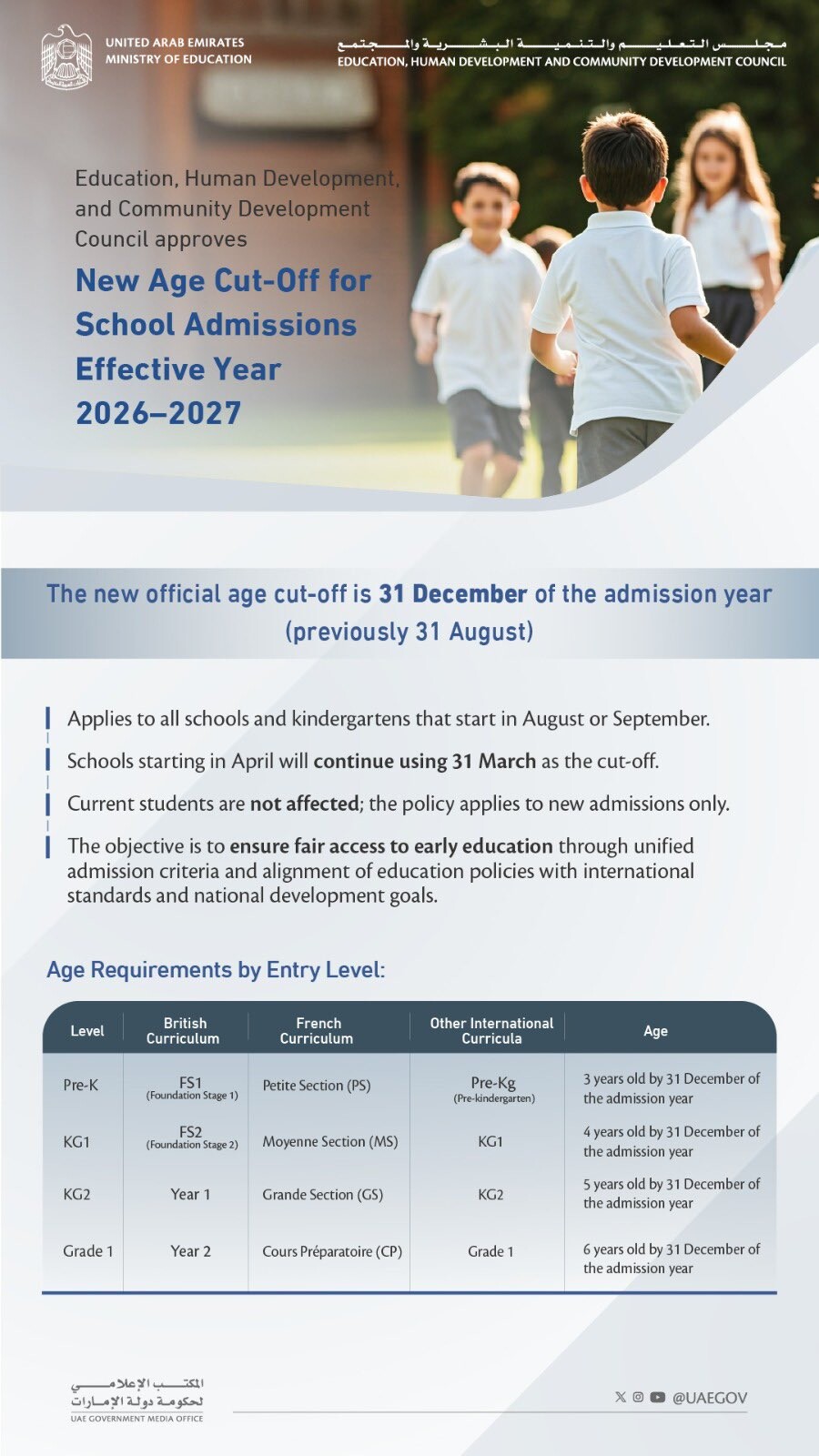
Up until now, children in Dubai (and across the UAE) had to reach the required age by 31 August of the year they were starting school to be eligible for:
- Pre-KG (now 3yrs old by 31st Dec.)
- KG1 (now 4yrs old by 31st Dec.)
- KG2 (now 5yrs old by 31st Dec.)
- Grade 1 (now 6yrs old by 31st Dec.)
That meant children born in September to December often missed the cut-off and had to wait a whole extra year to start school — even if they were developmentally ready. That’s now changing - From the 2026–2027 academic year, the KHDA has moved the age cut-off date to the 31st of December for schools whose academic year starts in August or September. Which the UK system does. Schools that start their academic year in April will continue to use 31st of March as their cut-off date.
What does that mean in real life?
Under the new rules, your child just needs to reach the required age at any point in the calendar year up to 31 December.
So for example:
- Turns 3 in November → eligible for Pre-KG that September
- Turns 4 in October → eligible for KG1
- Turns 5 or 6 before 31 December → eligible for KG2 or Year 1
In short: children born later in the year are no longer automatically forced to wait an extra year just because of their birthday. For many families — especially those juggling childcare, work, visas or even relocations — this is a genuinely welcome change. In our life, my son (a January born) will become one of the very oldest in his year. He is currently oldest-middle. For other families, there is a lot of fear of the unknown (understandably) and will they have to send their 2year old to "school".
Who does this affect (and who it doesn’t)?
- New admissions from 2026–27 onwards will follow the new December 31 rule
- Children already enrolled under the old rules won’t be affected
- Transfers between schools or curricula will still depend on progression, equivalency and individual school policies
So no, nobody is suddenly being moved up a year overnight.
But what do all these year groups actually mean?
This is where things get confusing — especially for expat families. Dubai schools follow different curricula, and they use different names for what are, developmentally, very similar stages. Here’s the simple, plain-English version.
Pre-KG = FS1 (foundation stage 1)- This is age 3-4 and is nursery / preschool. Think: play-based learning, social skills, early communication, fine and gross motor development and very gentle introduction to routine. No formal academics. No pressure.
KG1 = FS2 (also called reception) - This is age 4-5 and is still very much early years, but with a bit more structure. Focus is on: early phonics, foundations, number awareness, listening and attention, turn-taking, learning through play and school readiness. Still play-led. Still developmentally appropriate.
KG2 = year 1 - This is age 5-6, and where things start to feel a bit blurry in the different curriculums, as they begin to diverge slightly. Broadly speaking, children are similar ages — but Year 1 is styled in a more academic way than KG2.
KG2 (often Indian or IB-style systems)
- Still partly play-based
- Gradual increase in structure
- Focus on early literacy and numeracy
Year 1 (British curriculum)
- More formal learning begins
- Reading, writing and maths taught more explicitly
- Less play-based than FS1/FS2
Why this matters even more with the new cut-off
With the cut-off now moving to 31 December, many children born between September and December will be eligible to start earlier than before. But — and this is the important bit — eligibility does not equal readiness. Just because a child can start FS2, KG1 or even Year 1 earlier doesn’t mean they should, in a school setting at least. Probably controversial… but honestly? I would have kept my son in nursery forever if I could. We loved our time at Willow so much. Small class sizes, focus on real social skills for future set up, individualised learning opportunities....just a really 'homely' feel, without being lost in the crowd. No matter how good the teacher is, in my opinion, that's impossible to do in a class of 24 or 27. His FS2 class in Willow Nursery had 8 pupils. These are all things to take into consideration when choosing school vs nursery, or even nanny vs nursery.
My son moved into a school setting midway through FS2 purely so we could secure a place — which, sadly, happens a lot in Dubai. And then comes that nerve-wracking “Year 1 assessment” phase. They’re five (ish). What exactly are we assessing?! That's a topic for another blog I feel....
Things parents should actually think about
Much more important than a date on a calendar:
- Emotional maturity
- Attention span
- Language development
- Confidence and resilience
- Toilet independence
- Ability to cope with a structured day
This is especially important when choosing between:
- KG2 vs Year 1
- British vs non-British curriculum
- Starting early vs waiting a year
Dubai can feel very competitive around schooling. But development isn’t a race. A child who starts slightly later but feels secure, confident and emotionally ready often thrives far more than a younger child pushed ahead before they’re ready. Schools will talk about age cut-offs — but let’s be honest, most Dubai schools are also businesses. The teachers absolutely care about your child, but the person selling you early entry on a tour may be thinking about numbers as well as readiness. Parents need to think about the child in front of them, not the child the school wants to fill a place, or the race to secure a school place. Things are not set in stone- you CAN move your child if the environment isn't right.
Do you have to start your child just because they’re eligible?
Short answer (because this is what everyone wants to know): No. You do not. The December 31 cut-off defines eligibility, not obligation. If your child has a late birthday — say 29 December — and would be very young in their year group, you are absolutely allowed to not start them for a year. This is a parental choice, not a KHDA requirement.
Late birthdays and deferring: what’s normal?
A December-born child will be:
- Technically eligible
- One of the youngest in the year
Many parents — and educators — choose to hold these children back, particularly if:
- They’re emotionally young
- Attention is still developing
- Language or confidence needs time
- They’d be starting a more formal year (like Year 1)
This is common. It’s accepted. And it’s not “failing” your child.
British curriculum vs other curricula
British schools in Dubai are generally very familiar with deferred entry, especially for:
- FS1
- FS2 (Reception)
- Children with late summer or autumn birthdays
Most will support decisions based on emotional readiness rather than just age. They are somewhat restricted by whatever the current KHDA rules are, but that's a good conversation to have with them.
Other curricula (IB, Indian, American) can be:
- More flexible in some schools
- More rigid in others
Always ask the individual school, and get confirmation in writing if you’re deferring.
Does deferring cause problems later?
Usually, no — if it’s done clearly and properly.
Things to be mindful of:
- Future school transfers
- Curriculum equivalency
- International moves (UK, Europe, etc.)
Problems tend to arise when:
- A child is moved up or down informally
- There’s no clear documentation
A transparent, intentional decision is rarely an issue. We only need to look at the Swedish school system to see this. So if you don't feel that your child is ready, say so. There is no developmental advantage to being the youngest in the year. In fact, being slightly older often supports confidence, emotional regulation, leadership and long-term resilience. Dubai schooling can feel intense — but as my 5 year old often tells me, life isn’t a race, and there is no prize for starting first.
Important information
There is constant research in this field to ensure the safety of our children and guidelines and recommendations are updated regularly. Please remember that this article is a summary only of current guidance and check the links listed for more in-depth information. It is not intended to be an exhaustive list, only to be used as guidance. Your own country may also have their own guidance. If in any doubt about any aspect of your baby/child's care, please consult with your paediatrician.